Hiram Monthly Report
☆
Hiram Monthly Report ☆
Achievements
March 2026 was a defining month the formal implementation and ongoing refinement of a cigarette management behavior plan, the introduction of educational programming via a coding platform, and the emergence of consistent prosocial behaviors that had not been previously documented at this level of frequency. Across the full reporting period, Hiram demonstrated compliance with medication administration on every documented shift, participated in community outings to diverse locations including Gold's Gym, Dave & Buster's, Sports Academy, the AIM Center, multiple malls, Dollar Tree, Hooters, and Champy's, and maintained a behavioral baseline that was largely free of aggression or significant escalation. The most persistent clinical concerns were nicotine-seeking behaviors — which ranged from passive fixation to active boundary-testing, camera avoidance, fence-area access attempts, and cigarette butt searching — and chronic daytime sleepiness that impacted activity engagement and daily living task completion. Hiram ended the month with a string of calm, self-directed, and prosocial shifts, suggesting a stabilizing behavioral trend heading into April.
Achievements
Hiram achieved several notable milestones during March that reflect genuine growth in independent living skills, social development, and self-regulation.
On March 1, during the first shift, Hiram woke independently to his alarm without any additional prompting — the first documented instance of fully independent morning wake-up during the reporting period. He completed his entire morning hygiene routine including showering without issue, prepared and ate breakfast appropriately, took his prescribed medications without resistance, and then engaged in cleaning tasks within the home with minimal prompting. He went further by appropriately prompting peers to participate in cleaning, demonstrating social initiative that extended beyond his own responsibilities. He also assisted staff with taking trash to the dumpster without complaint.
The introduction of the coding platform on March 18 during the second shift represented a significant educational achievement. Hiram completed two full coding lessons during the initial session, demonstrating sustained focus on a structured educational activity. By March 22, he was voluntarily discussing his coding assignments with staff, expressing pride in the work he had completed. This represents the establishment of an entirely new skill-building domain that Hiram engaged with independently and spoke about with genuine enthusiasm.
On March 5, Hiram completed his AIM Center application, taking a concrete step toward future programming and community integration. This was followed by his appropriate participation in the AIM Center tour on March 4, where he remained calm and engaged throughout the visit.
On the evening of March 30, Hiram independently troubleshot a problem with his gaming system, spending approximately 30 minutes working through the issue and expressing visible excitement when he resolved it on his own. This problem-solving accomplishment reflects developing self-efficacy and persistence.
Throughout the final week of March, Hiram consistently cleaned up after himself without prompting — after snacks, meals, and gaming sessions — demonstrating internalization of household responsibility expectations that had previously required staff reminders.
Challenges
The most significant and persistent challenge throughout March was nicotine-seeking behavior, which manifested across a spectrum of intensity and strategy. During the first week at the original residence, cigarettes were managed proactively as part of a behavior plan: On March 1, he did not request any cigarettes and did not engage in pacing, representing optimal baseline behavior within the plan. However, by March 5, the behavior had escalated considerably. During a mall outing, Hiram asked to use the restroom under circumstances that suggested he might be attempting to obtain prohibited items. When preparing to leave Dave & Buster's, he asked to go outside to finish a cigarette he claimed was from earlier, and when staff asked him to show the cigarette, he hesitated and appeared nervous. Staff determined that Hiram was aware the deception had been recognized. Following this incident, staff informed him that once his remaining cigarettes were finished, he would need to manage without additional ones.
On March 6, the nicotine-seeking behavior intensified further. Through camera monitoring, staff observed Hiram intentionally positioning himself in areas outside the cameras' direct view. He was observed attempting to exit the property through the back area near the fence, and he was searching the ground for discarded cigarette butts. These behaviors persisted into the second shift of the same day, when he repeatedly exited and re-entered the house through the back door while continuing to search the backyard for cigarette remnants. The camera avoidance and fence-area behaviors were the most concerning manifestations of the month, as they suggested potential elopement risk tied to nicotine acquisition.
The cigarette-related stress was not limited to seeking behaviors. On March 20 during the second shift, Hiram became visibly distressed about wanting a cigarette, moving back and forth between his room and the living room in a restless pattern. Staff provided verbal encouragement, reminding him of his progress, and he was eventually able to settle. On March 17, during a community outing to Walmart, Home Depot, and Sports Academy, staff observed that Hiram lit a cigarette before entering and after leaving every store — quick puffs that appeared designed to maximize nicotine intake during the outing. He smoked all three of his allotted cigarettes before dinner and then asked when he could be trusted with his own pack. Staff responded that he could not be trusted, and he accepted this without escalation. However, he remained fidgety for the remainder of the evening, clearly wanting a cigarette, until he eventually settled watching a movie.
The second major challenge was chronic daytime sleepiness. Across nearly every documented shift, Hiram returned to sleep between activities. On March 18, the pattern was particularly pronounced: he woke up, used the bathroom, went back to sleep, got up again for medications and breakfast and a cigarette, then went back to sleep, was woken up for Gold's Gym, returned and went for a walk, then returned to sleep again. This pattern was documented consistently through March 31. On March 16, he had to be woken up three separate times — for his 3:00 PM medication, for a phone call with his mother, and for dinner. On March 23 during the third shift, he complained that he needed melatonin to fall asleep, despite the fact that daytime sleepiness was simultaneously a documented concern. The persistent nature of this pattern across both residences suggests it may be medication-related or reflect an underlying sleep quality issue rather than simply behavioral avoidance.
Attention-seeking and boundary-testing behaviors constituted a third challenge area. On March 3 at the movie theater during Scream 7, Hiram talked loudly during the movie, placed his feet on the back of the chair in front of him, and was observed watching and following the movements of people around him in an unusual manner. Staff redirected him multiple times. On March 4, he was following staff closely around the house, requiring a reminder about maintaining appropriate personal space. He apologized and the behavior stopped. On March 5, staff noted that he had been taking an average of three showers per day and using large amounts of soap, a pattern that warranted monitoring for potential compulsive or attention-seeking function.
Progress Updates
Hiram's progress toward medication compliance remained at 100% throughout the reporting period. Across every documented shift at both Lincoya Bay and Oak Residence, he took his prescribed medications as scheduled without resistance. This represents sustained reliability in a critical area of health management.
Progress in community integration advanced significantly during March. The AIM Center tour on March 4 was completed without behavioral incident, and Hiram remained calm and participatory throughout. His completion of the AIM Center application on March 5 moved his community programming forward concretely. The walking outing on March 12 generated spontaneous positive self-advocacy when he asked staff to communicate his desire to return. Community outings throughout the month — Walmart, the mall, Dollar Tree, CVS, Sports Academy, Home Depot, Hooters, Champy's, Dave & Buster's, and various drives around the Chattanooga area — were completed without aggressive incidents, and Hiram demonstrated generally appropriate public behavior with the exception of the March 3 theater outing.
Physical activity engagement progressed from non-existent at the start of the month to a semi-regular pattern by mid-March. Gold's Gym was introduced on March 18, and Hiram participated when prompted. He expressed eagerness to work out during the March 17 outing, asking to find a gym while driving around. The trampoline at the residence served as an additional physical outlet, with documented use on March 4 across both the first and second shifts. The March 24 Gold's Gym outing was completed without incident, and the walking outing on March 12 generated the strongest positive response of any physical activity during the month.
Cigarette management progressed through identifiable phases. During the first phase (March 1–4), Hiram did not request cigarettes at all on March 1, and proactive provision during mildly fidgety moments was sufficient to manage the behavior. The second phase (March 5–6) saw escalation to active deception, camera avoidance, fence access attempts, and cigarette butt searching, representing the lowest point in the management plan. The third phase (March 17 onward at Oak Residence) stabilized into a pattern of managed provision with intermittent stress episodes. By the final week of March, cigarette breaks were occurring as part of a routine schedule — typically one after meals and one before bed — without the camera avoidance or elopement-risk behaviors observed earlier. While the fixation persisted, the behavioral manifestation had de-escalated measurably from the mid-month peak.
Hygiene routine compliance improved from requiring extensive prompting in the first week to a more predictable pattern by month's end. On March 3, staff had to explicitly condition community outings on completion of hygiene and room cleaning before departure. By March 26, Hiram was completing his shower and independently putting a load of laundry in the washing machine, despite expressing tiredness. On March 31, he independently took a bath at 9:30 AM. The trajectory indicates gradual internalization of hygiene expectations, though prompting remains necessary on most days.
New Insights and Patterns
The coding platform introduction on March 18 revealed a previously undocumented capacity for sustained educational focus. Hiram completed two lessons in a single session and voluntarily discussed his progress with staff days later. The coding activity appeared to serve a dual function — both as genuine skill development and as a high-engagement distraction from cigarette fixation during the second shift when he would otherwise be idle and "indirectly waiting for cigarettes," as staff noted. This dual function positions the coding platform as a strategically valuable intervention.
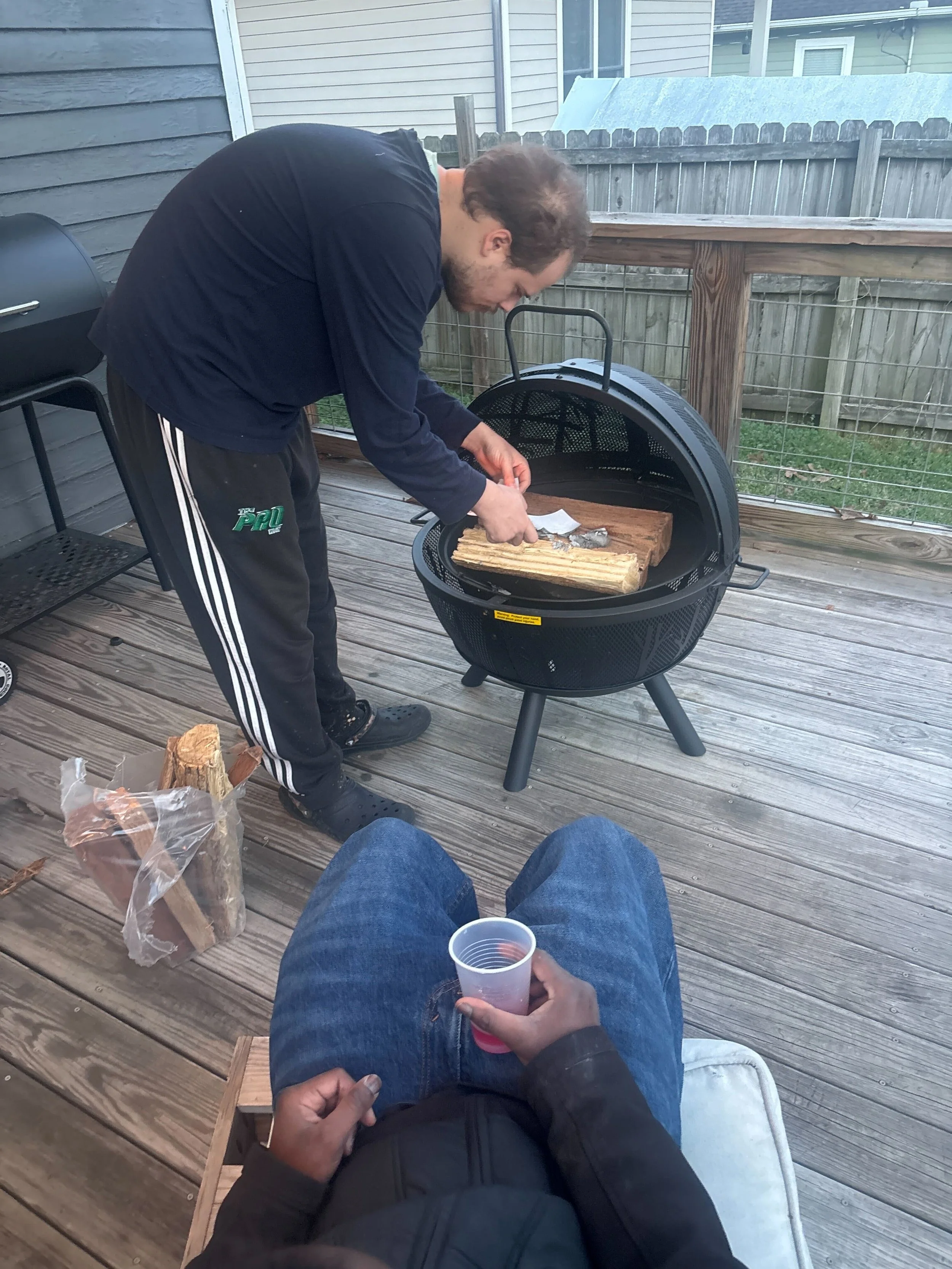
A clear functional relationship emerged between idle time and nicotine-seeking behaviors. On every shift where Hiram was actively engaged in a structured activity — the fire pit, community outings, gaming with peers, the coding platform, or the walking outing — cigarette requests and seeking behaviors were absent or minimal. Conversely, the most intense cigarette-seeking episodes (camera avoidance on March 6, fence access attempts, cigarette butt searching) occurred during periods of unstructured time at the residence. This pattern suggests that nicotine fixation serves an anxiety-management or boredom-coping function and that increasing structured engagement is the most effective environmental intervention.
A prosocial behavioral trend emerged during the second half of the month that was not documented in prior reporting periods at this frequency. On March 20, Hiram independently helped staff assist a peer with bathroom needs and diaper disposal. On March 23, he helped assist staff with a peer during a community outing. On March 27, when a peer began crying about wanting his clothes, Hiram spontaneously sang to cheer him up and offered his drink to the peer. On March 30, he assisted with peer supervision on two separate occasions and attempted to help staff wash a peer on March 31. This clustering of empathetic and supportive peer interactions represents a significant development in social functioning.
Hiram's sleep architecture revealed a paradoxical pattern: excessive daytime sleepiness coexisted with difficulty initiating sleep at night. Late bedtimes of 12:30 AM (March 26), 1:30 AM (March 23), and 2:00 AM (March 22) were documented, along with a specific complaint that he needed melatonin to fall asleep (March 23). Yet during daytime hours, he consistently returned to sleep between activities and was described as reporting feeling sleepy even during outings (falling asleep in the car on March 12 and March 17). This paradoxical pattern may indicate a circadian rhythm disruption, medication side effect, or sleep quality issue that warrants medical evaluation.
The social interaction at Hooters on March 6 — where Hiram obtained a waitress's phone number and subsequently received a text response — produced the single largest positive mood shift of the month. Staff observed significantly elevated mood, extended conversation about the interaction, and excitement that persisted across three shifts. This response suggests that age-appropriate social connection and romantic interest are powerful motivators for Hiram and represent potential leverage points for behavioral programming.
The anxiety-following behavior observed on March 4 (following staff around the house) and March 22 (following staff to the car, needing to be asked if he was alright) appears to correlate with shift transitions or periods of uncertainty. Both instances resolved quickly once Hiram was engaged in conversation or activity, suggesting that brief check-in protocols at shift changes could preemptively address this pattern.
Areas for Improvement
The cigarette management plan should be refined based on March data. The current proactive provision model (offering cigarettes when mild fidgetiness is observed) was effective during the first phase of the month but did not prevent escalation during the second phase. A structured schedule with fixed cigarette times — independent of behavior — may reduce the fixation by removing the uncertainty that appears to drive seeking behaviors. The coding platform, gaming sessions, and physical activities should be strategically scheduled during periods when cigarette fixation historically peaks (typically late morning and early evening).
The daytime sleepiness pattern requires medical evaluation. Staff should document sleep and wake times systematically over a two-week period to provide the treatment team with objective data for assessing whether the pattern is medication-related, sleep-hygiene-related, or indicative of a medical condition. If melatonin is being considered per Hiram's own request, this should be discussed with the prescribing provider in the context of the full sleep pattern rather than as an isolated request.
The coding platform should be expanded from an ad hoc activity into a structured daily or regular-interval programming element. Hiram demonstrated genuine engagement and pride in his coding progress. A formalized schedule of coding sessions — with tracked lesson completion and discussed milestones — would provide educational development, a positive alternative to idle time, and a concrete accomplishment framework that supports self-efficacy.
Peer support responsibilities should be formalized cautiously. While Hiram's prosocial behaviors in the second half of March were encouraging, the peer supervision tasks (watching a peer who requires constant monitoring) should be time-limited and supplementary to — not a substitute for — trained staff supervision. Formal acknowledgment of Hiram's helpfulness through verbal praise and potentially a peer mentor role within appropriate boundaries would reinforce the prosocial trend while maintaining safety standards.
Physical activity programming should be regularized. The Gold's Gym visits and the walking outing produced positive engagement and reduced nicotine fixation. A minimum of three structured physical activity sessions per week should be targeted, with variety (gym, walking outings, trampoline, ball activities) to maintain engagement. Hiram's expressed interest in working out should be leveraged as a motivational anchor.
The excessive showering pattern (averaging three per day with large soap usage, as noted on March 5) should be monitored for frequency and function. If the pattern persists, a functional assessment should determine whether the behavior serves a sensory, compulsive, or avoidance function, and appropriate programming should be developed accordingly.
Visual Summaries and Data Charts
Behavioral Frequency Table — March 2026
Weekly behavior tracking shows rising cigarette-related requests late in the month, increasing prosocial peer support, more independent hygiene near month end, and later bedtimes during the final week.
| Behavior Category | Week 1 3/1–3/7 |
Week 2 3/8–3/14 |
Week 3 3/15–3/21 |
Week 4 3/22–3/31 |
|---|---|---|---|---|
| Cigarette Requests | 0 Proactive provision | 1 documented | 2 documented | 3 documented |
| Cigarette Butt Searching | 0 | 0 | 0 | 0 |
| Camera Avoidance | 2 (3/6 both shifts) | 0 | 0 | 0 |
| Fence / Elopement Risk | 1 (3/6) | 0 | 0 | 0 |
| Attention-Seeking (theater/following) | 3 (3/3, 3/4, 3/4) | 0 | 0 | 1 (3/22) |
| Prosocial Peer Support | 1 (3/1 prompted cleaning) | 0 | 1 (3/20) | 4 (3/23, 3/27, 3/30, 3/31) |
| Independent Hygiene (no prompt) | 1 (3/1) | 0 | 0 | 2 (3/26, 3/31) |
| Late Bedtime (after midnight) | 0 | 0 | 0 | 3 (3/22, 3/23, 3/26) |
| Community Outing Participation | 6 | 1 | 4 | 6 |
| Coding Platform Engagement | 0 | 0 | 1 (3/18) | 1 (3/22 discussion) |
ABC Analysis — Key Behavioral Events
These sequences summarize notable events related to nicotine access, environmental overstimulation, empathy toward peers, and stress regulation.
Absence of cigarettes after a prior boundary conversation and unstructured time at the residence with few engagement options.
Positioned himself outside camera view, attempted to exit near the fence, and searched the ground for discarded cigarette butts.
Staff increased supervision and accompanied him on a supervised drive. He stayed calm and cooperative, and the behavior did not recur later in the month.
Community outing to a movie theater with high stimulation, unfamiliar people, and reduced direct staff interaction.
Talked loudly, put feet on the chair in front of him, and followed other moviegoers with unusual attention.
Staff gave repeated verbal redirections. He complied only intermittently but settled after returning home. No more theater outings occurred that month.
A peer became visibly upset and cried about wanting clothes.
Hiram spontaneously sang to cheer the peer up and offered his drink.
Staff noted the behavior positively, the peer appeared to benefit, and Hiram remained calm. This was the most empathetic spontaneous response documented.
Extended time at the residence without a cigarette while intermittently watching a show on the couch.
Moved restlessly between his room and the living room and appeared visibly stressed about wanting a cigarette.
Staff offered verbal encouragement, he settled, and returned to watching the show without escalation, aggression, or elopement risk.
Mood Tracking Summary
Mood shifted from early preoccupation and nicotine-related stress to a more stable, social, and prosocial presentation by late March.
Sleep Pattern Overview
Sleep shifted later as the month progressed, with late-March gaming correlating with later bedtimes and continued daytime napping.
Take a Look at Hiriam in Action…